Risk assessment tool
Determining risk of periodontal diseases initiation/progression
The diagram below shows a basic risk assessment tool which might be helpful when determining the risk of periodontal disease initiation/progression in an individual patient and to inform the appropriate recall interval.
N.B. This is not a validated tool, but has been provided as a guide to aid in the assessment of risk.
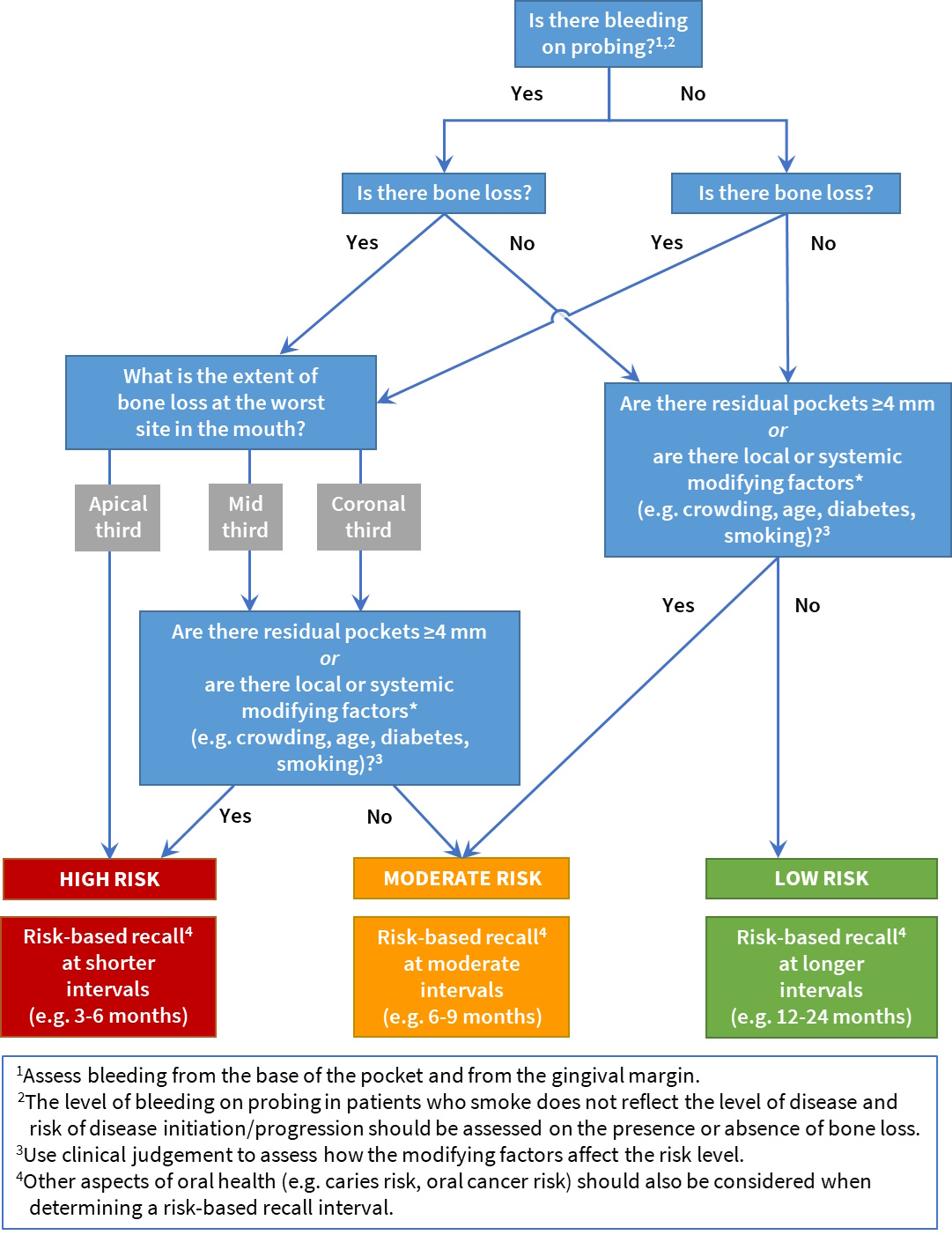
1. Is there bleeding on probing?a,b
If yes, go to 2. Is there bone loss?
If no, go to 5. Is there bone loss?
If yes, go to 3. What is the extent of bone loss at the worst site in the mouth?
If no go to 6. Are there residual pockets ≥4 mm or are there local or systemic factors?
3. What is the extent of bone loss at the worst site in the mouth?
If apical third: go to HIGH RISK
If mid third or coronal third: go to 4. Are there residual pockets ≥4 mm or are there local or systemic factors?
4. Are there residual pockets ≥4 mm or are there local or systemic factors (e.g. crowding, age, diabetes, smoking?)c
If yes: go to HIGH RISK
If no: go to MODERATE RISK
If yes, go to 3. What is the extent of bone loss at the worst site in the mouth?
If no, go to 6. Are there residual pockets ≥4 mm or are there local or systemic factors?
6. Are there residual pockets ≥4 mm or are there local or systemic factors (e.g. crowding, age, diabetes, smoking?)c
If yes: go to MODERATE RISK
If no: go to LOW RISK
Recall intervals based on patient risk:
HIGH RISK: Risk-based recalld at shorter intervals (e.g. 3-6 months)
MODERATE RISK: Risk-based recalld at moderate intervals (e.g. 6-9 months)
LOW RISK: Risk-based recalld at longer intervals (e.g. 12-24 months)
- Assess bleeding from the base of the pocket and from the gingival margin
- The level of bleeding on probing in patients who smoke does not reflect the level of disease and risk of disease initiation/progression should be assessed on the presence or absence of bone loss
- Use clinical judgement to assess how the modifying factors affect the risk level
- Other aspects of oral health (e.g. caries risk, oral cancer risk) should also be considered when determining a risk-based recall interval.