BPE 3 management flowchart
BPE 3 management flowchart
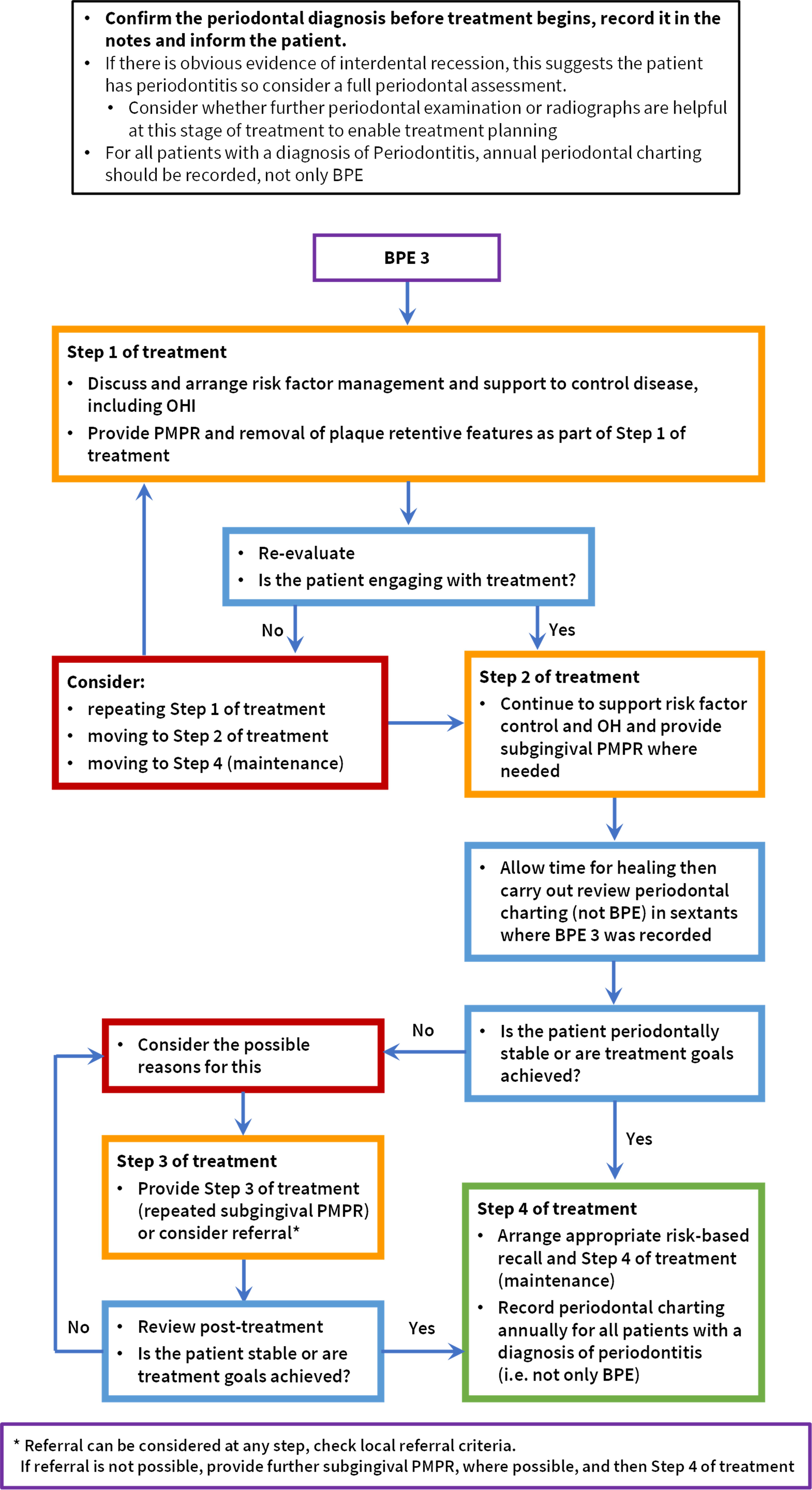
- Confirm the periodontal diagnosis before treatment begins, record it in the notes and inform the patient.
- If there is obvious evidence of interdental recession, this suggests the patient has periodontitis so consider a full periodontal assessment.
- Consider whether further periodontal examination or radiographs are helpful at this stage of treatment to enable treatment planning
- For all patients with a diagnosis of Periodontitis, annual periodontal charting should be recorded, not only BPE
1. Provide Step 1 of treatment
- Discuss and arrange risk factor management and support to control disease, including OHI
- Provide PMPR and removal of plaque retentive features as part of Step 1 of treatment
- Re-evaluate
2. After Step 1 of treatment, is the patient engaging with treatment?
If yes:
-
- Move to Step 2 of treatment
If no:
Consider:
-
- Repeating Step 1 of treatment
- Moving to Step 2 of treatment
- Moving to Step 4 of treatment
3. Provide Step 2 of treatment
- Continue to support risk factor control and OH and provide subgingival PMPR where needed
- Allow time for healing then carry out review periodontal charting (not BPE) in sextants where BPE 3 was recorded
4. After Step 2 of treatment, is the patient periodontally stable or are treatment goals achieved?
If yes:
If no:
-
- Consider the possible reasons for this.
- Provide Step 3 of treatment (repeated subgingival PMPR) or consider referral*
- Review post-treatment - is the patient stable or are treatment goals achieved?
- If yes - provide Step 4 of treatment
- If no - consider the possible reasons for this; repeat Step 3 of treatment or consider referral*; review post-treatment
* Referral can be considered at any step, check local referral criteria.
If referral is not possible, provide further subgingival PMPR, where possible, and then Step 4 of treatment